




 Click it and Unblock the Notifications


Latest Updates
-
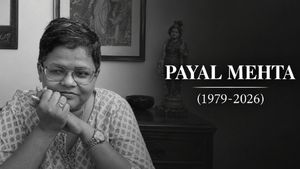 Senior Journalist Payal Mehta Passes Away At 46; PM Modi, Rahul Gandhi, Other Political Leaders Pay Tributes
 -
 Alia Bhatt’s Ganesh Chaturthi 2026 Looks Were All About Custom Kurtas, Colour And Modern Festive Style
 -
 Weekend Read: Salman Khan Goes Shirtless on BB 20, Gives Trolls a Befitting 'Come Troll Me' Reply
 -
 World Cleanup Day 2026: Why ‘Clean Plates’ Could Be The Secret To Cleaner, Greener Cities
 -
 Deepika Padukone Welcomes Second Daughter With Ranveer Singh, A Day After Siddhivinayak Temple Visit
 -
 Penelope Cruz Steps Onto The TIFF Red Carpet In A Statement High Jewellery Look
 -
 Raaka Teaser: Allu Arjun And Atlee’s ₹1,000 Crore Sci-Fi Epic Gets A Cryptic Global Triumph Tease
 -
 Nita Ambani’s Amrapali Bharatam Necklace For Ganesh Chaturthi Has An Interesting Connection To Sonam Kapoor
 -
 Oscars 2027: ‘Gondhal’ Selected As India’s Entry, ‘Dhurandhar’ Among Major Films That Missed The Cut
 -
 Ruokamill Protein For Women: Honest Review, Health Benefits And Best Time to Take It


Satsang With Swami Chinmayananda-Scriptures And Puranas


First when we hear of these assertions in the scriptures, the unprepared student refuses to believe them. Do they really exist only as fancy visions - in the inflamed imagination of the seers? In case they do exist, can they be clothed in language to take form and manifest as understandable ideas? Herein we find the despair of the Rishis, the voiceless sorrows of the seers. Truth is inexpressible; and yet, nothing expresses itself so vividly at all times and in every place.
What exactly is the difference between scientific investigation and intuitive knowledge? Is not the purpose of both the same?
The scientist's attitude to his investigation has been beautifully summarised by Mottram when he says, "the truly scientific scientist admits that all he is doing is to produce order out of a chaotic mass of sense impressions by means of hypotheses, all of which include "as if', in them, He tells us how things behave but goes no further. Be makes no attempt to penetrate behind the sense data that he investigates.
The mystic or the philosopher apprehends the truth intuitively, wherein he comes to be that in which the investigator, the object-investigated and the very processes-of investigation, all merge together into the 'One Principle,' This is called the 'intuitive knowledge.'
What are these Puranas? Are not the Upanishads our scriptures? How then did these bulky literature of exaggeration and poetic fancies come to be considered as divine?
Compressing maximum language into minimum of thought is the style of the Puranas. They are as compared with the literary style of the Upanishads sheer Marathon verbal performances. The Upanishads follow a totally different method altogether. Compressing maximum of thought into mimimum of language is the style of Upanishads; nowhere in the annals of the world literature can we see the art of brevity so admirably fulfilled.
Vedanta with its theory of illusions has unnecessarily smashed my world of beauty and scientific achievements. This is a crime against the man and I impeach Vedanta.
You may. In that case Sri Vedanta must produce an array of another serious and deeper scientists from your own family of Doctors of Science, as his defence witnesses! Just listen, Sir, to Arthur Edington's own words, “the external world of physics has thus become a world of shadows. In removing our illusion, we have removed the substance, for, indeed, we have seen that substance is one of the greatest of our illusions. It was in the Bible that I read Doctor Cure Thyself"
About the author
Swami Chinmayananda the great master's lectures were an outpour of wisdom. He introduced the Geetha Gnana Yagna. He wrote a lot of books on spirituality, commentaries to Vedantic texts, children books etc. He then started spreading His teachings globally.....

 Continue with Google

