




 Click it and Unblock the Notifications


Latest Updates
-
 Who Is Ravleen Varghese? Meet The First Malayali Model To Walk The Victoria’s Secret Runway
 -
 World Osteoporosis Day 2026: A Minor Fall, A Major Fracture — Doctor On Why Older Adults Should Be Careful
 -
 Durga Visarjan 2026: October 20 or 21? Know Shubh Muhurat, Rituals And Significance
 -
 Happy Dussehra 2026: 50+ Wishes, Messages And Greetings To Share With Family And Friends
 -
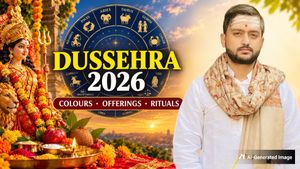 Dussehra 2026: Astrologer Ashutosh Clairvoyant On Colours, Offerings And Puja Rituals For Each Zodiac Sign
 -
 Hustle Culture Has a Bedroom Problem No One Talks About, Expert Explains
 -
 Iris Young Minds Initiative: How A Noida CSR Programme Is Opening Up Talk On Student Stress
 -
 Lal Hit Janta Party Explained: Who Is Behind The Rival to the Cockroach Janta Party
 -
 Barbara Palvin In Victoria’s Secret Fashion Show Six Weeks After Birth
 -
 Maha Navami Significance: Why The Ninth Day Of Navratri Matters Most


The Major Differences Between Yoga, Meditation, & Pranayama

Despite the fine lines between the three-Yoga, Pranayama, and Meditation-they are confused with each other more than often. It stands true that all three of them aim at offering you better health and a peaceful and tranquil lifestyle. But in terms of methodologies and approaches, the relationship between them is a bit complex.
The ancient scriptures of Yogsutra separate the three, distinctly, as physical fitness, mental health, and spiritual awareness.

While Yoga is often mistaken as a form of 'exercise' only, very few are aware that Meditation or Dhyana is considered a part of Yoga. On the other side, Pranayama should be practiced along with the two for comprehensive physical and mental benefits.
Let's dive deeper and find out the key differences between them.
Yoga
With its origin in ancient India, Yoga is the generic term coined for physical, mental, and spiritual practices aimed at attaining a state of permanent peace.
It comprises of yogic exercises which cater to the entirety of human body-internal, external, and mental stability. If followed regularly, in a particular pattern, Yoga is said to not only enlighten the body but also bring freshness into it. It even helps you mould and control your feelings.
Broadly, yoga includes eight forms of practices:
1. Yama (truth and non-violence)
2. Niyam (five healthy habits)
3. Asana (more famous as an exercise)
4. Pranayama (breathing exercise)
5. Pratyahara (withdrawal)
6. Dharana (Concentration on objects)
7. Dhyana (meditation)
8. Samadhi (merging consciousness with the object of meditation).
It's said that on practicing all eight, one can achieve physical, mental, and spiritual fulfilment. From Yama to Samadhi, all the eight subdivisions are created with a central basic philosophy-to establish a direct contact with the creator of this universe.
This connection is believed to give yogis the ultimate feeling of satisfaction and unbolt doors to infinite joy. Other advanced stages of Yoga bring to life good health along with peace of mind.
So, breaking the myths, let us all get it straight that Yoga is not only limited to Asana; it is, rather, much beyond and above that.
Pranayama
Wikipedia defines Pranayama as the "extension of 'pran' or breath or, extension of the life force." And this is why it is considered as 'the yoga of breathing'.
This divine and spiritual method of concentration involves breath inhalation and exhalation exercises. Pranayama is also believed as the most perfect and efficient way to bring the mind under control-it helps one gain internal stability and, consequently, focus on their goals.
Pranayama is generally practiced by sitting in "padmasana" and concentrating on slow and steady breathing. Some also practice it by concentrating on rapid inhalation and exhalation-this type is known as 'kapalbhati'.
Pranayama results in you being able to control your breathing system and regulate it in the right directions. Pranayama yogis are trained over years for prolonging and controlling breathing systematically. In short, with Pranayama, you become a master of your breathing function.
Meditation
Meditation is an advanced level of Samadhi. A meditator has to be a master of his mind and his concentration and focusing powers need to be much sharper. Meditation is adapted by thousands now in order to get rid of the unexpected attacks of stress and depression.
A religious meditation practitioner always tries to live in the moment and analyze all the changes that are taking place within as well as outside his/her body.
In fact, Dhyana (another term for meditation) is indeed the first step towards 'clearing consciousness.' It is not simply sitting in silence with a particular body posture, as most people perceive it to be. It rather is a far more profound technique of transporting one's mind and soul to the next level of human consciousness.
There are more than one ways to follow and practice Yoga, Pranayama, and Meditation. Before undertaking any, consulting with a subject expert is highly recommended.
Let us know your thoughts in the comments section below.
Disclaimer: The information provided in this article is for general informational and educational purposes only and is not intended as a substitute for professional medical advice, diagnosis, or treatment. Always seek the advice of your physician or a qualified healthcare provider with any questions you may have regarding a medical condition.

 Continue with Google

