




 Click it and Unblock the Notifications


Latest Updates
-
 Who Was Mithu Mukherjee? Veteran Bengali Actress Passes Away At 71
 -
 Ahmedabad Police Flag Fraud Risk Behind Viral 'Rent A Garba Partner' Ads
 -
 Vidya Balan’s Jailer 2 Entry As Kantha: From Silk To Manjulika, A Look At Her Unconventional Roles
 -
 Samay Raina Has Now Denied Dating Rumours With Two Women In Three Months
 -
 Kareena Kapoor Turns 46: From Size Zero To Fine Lines, The ‘Daayra’ Actress Is Choosing To Age Without Apology
 -
 The Emotional Side of Delayed Parenthood That We Don’t Talk About Enough
 -
 World Alzheimer’s Day 2026: Why Early Diagnosis Matters And What This Year’s Theme Means
 -
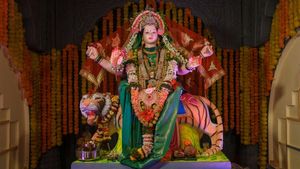 When Is Navratri In 2026? Full Dates, Rituals, Colours, Significance, and Fasting Guide
 -
 Vijay Sethupathi Confirms Maharaja 2, Hollywood Remake In The Works
 -
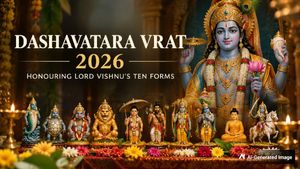 Dashavatara Vrat 2026: Everything To Know About Tithi, Rituals, Fasting And The Ten Forms Of Lord Vishnu


The Eternal Message Of The Gita-The Seer And The Seen-V


Now that we have made it our objective to obtain the highest knowledge, we find that we are prevented from doing so by our psychological automatisms. That is why we have to accomplish, indefatigably, the inner work which our intellectual intuition calls forth and encourages. At the same time this inner work is bound to end in an impasse. The words spoken by Sri Ramakrishna in this context are most significant: 'When will I be free?—When the "I" ceases to be.' Now, then, it is not just through an analysis of the mental processes that this 'I' will go. On the contrary, the more it is studied, the more it asserts itself. It is only through a rigorous enquiry that we shall be able to grasp our experiences as an integral whole, and not as a combination of different fragments. The metaphysical intuition is an 'infused' knowledge which comes with the letting go of the ego, when everything has been renounced. (Gita, 18.66)
After letting go of the ego, only one vision remains: that of the Lord, that of the Kshetrajna who is behind all the Kshetras, including our ego. The power of ignorance (avidya) is employed to direct our attention to 'name' and 'form' (nama-rupa) which are constantly changing, and the reality then seems to be divided into innumerable 'seens'. To the sage, however, there is no such multiplicity in the 'seen', and his vision is not attended by mental tension. If the ordinary vision may be compared to a circle, the centre of which is fixed, while its circumference represents the infinity of objects perceived, the vision of the sage, on the other hand, does not have a centre. Or rather, its centre is everywhere and its circumference nowhere, according to the expression of Pascal which was frequently quoted by Swami Vivekananda.
In this perspective the apparent conflict between the 'seen' and the 'seer' is solved. The Kshetrajna is the metaphysical 'reality', the akshara, the Lord. Remaining in each 'seen', the 'seer', 'That which does not perish, when all has perished,' is the infinite possibility of 'seens'. Shankara says that 'our experience of the world is a continuous perception of Brahman'.
About the author
Swami Siddheswarananda (1897-1957) was a monk of the Ramakrishna Order, and for twenty years until his death, the spiritual head of the Centre Vedantique Ramakrichna at Gretz, France. This commentary of the learned Swami on the various themes of the Gita was orginally published in French in the 'Bulletin of the Centre Vedantique' during 1955-57. This article is the fifth instalment of a series of about a dozen articles, each independent in itself. English translation and editing was done by Mr. Andre van den Brink.
Chat With The Devotees Of Ramakrishna Paramahamsa

 Continue with Google

