




 Click it and Unblock the Notifications


Latest Updates
-
 Vighnaraja Sankashti Chaturthi 2026: Know The Date, Significance, Vrat Katha And Moonrise Fasting Rituals
 -
 Taylor Swift Makes VMA History: All About Her Record-Breaking Night And Striking Red Carpet Look
 -
 Bank Holidays October 2026: Check State-Wise List Before Visiting Your Branch
 -
 October 2026 Festival Calendar: Pitru Paksha Ends, Navratri Begins, Dussehra Follows
 -
 Pitru Paksha 2026: What To Eat And Avoid, According To Astrologer Gauri Jain
 -
 Guide to Surviving Festive-Season Humidity While Hosting: An Expert Shares Tips on Choosing Fabrics
 -
 Is Your Makeup Causing Breakouts? A Dermatologist Explains
 -
 You Don't Need an MRI for Every Backache: What a Physiotherapist Looks For First
 -
 Who Is Tanya Mishra? The Model-Actress Fans Are Calling A National Crush
 -
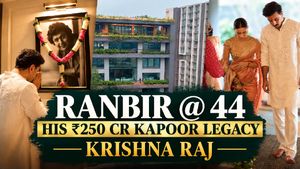 Happy Birthday Ranbir Kapoor: Inside 'Ramayana' Actor's ₹250 Crore Krishna Raj Home Built Around Kapoor Legacy


Spiritual Practice In Solitude ( Sri Ramakrishna On The Need For Solitude III)


One of the ways of preparing oneself for a retreat into solitude is to read the lives of saints and sages who did intense spiritual practice in solitude. Books such as The Imitation of Christ and The Eternal Companion. which deal with related subjects, help a great deal in preparing the mind. One may also gradually increase the number of sittings and the duration of meditation and the number of japa for a fortnight or a month before the actual retreat. Although the mind may not get sufficiently concentrated during such extra sittings, the body will get accustomed to sit longer in the meditation posture. The practice of silence for as long a period as possible and avoiding all unnecessary conversation are also a help in quietening the mind and attaining inner solitude.
The spot for the solitary retreat must be carefully selected. A quiet place with natural settings like a river bank, or a cluster of trees, or a hillside is best for the purpose. But a holy place or a place of pilgrimage, where the company of devotees and holy men is near at hand, is better for a novice. If he is planning the retreat for the first time he must preferably go to an established Ashrama. Although he may not like to associate with others, and may wish to talk to God rather than about God, such holy company available at hand may prove immensely helpful during periods of dryness and difficulty.
Another thing to remember is that one must not plan a long retreat initially. For a generally busy person one week or even three days are enough to begin with. Of course, no hard and fast rule can be made in this regard.
Some people may have the ability to live in solitude immediately after an intensely active life without prior preparation and yet derive full advantage from it. But it is always safer to be on guard and begin with shorter retreats. It often happens that the first few days are spent well in japa and meditation, but as the days pass by, the intensity of spiritual practices lessens and dryness sets in. During initial retreats, one must not overtax the brain by trying to do too much japa and meditation. Instead, it is best to prepare a mixed daily routine consisting of japa and meditation, scriptural studies, ritualistic worship, singing of devotional songs, etc. Thus the monotony and dryness can be avoided and yet the mind can be kept on a higher spiritual level.
If one is not able to meditate well, one may switch on to scriptural studies. If the body feels dull and lethargic, one may do some chores of the Ashrama. Monastic seekers may go for begging, which in itself is a good spiritual exercise. After thus gaining a firsthand experience of living in solitude, the spiritual seeker may plan it better the next time. Let him go for longer periods into solitude during successive retreats and gradually increase the time spent in japa and meditation. The time devoted to physical activity and scriptural studies may be gradually reduced. Keeping before the mind the aim of ceaselessly remembering God and diving deep into meditation on Him, the seeker must make each succeeding retirement into solitude more intense than the earlier one.
Conclusion
After such retreats of longer or shorter duration, one must return to one's field of activity. It must be remembered that solitude and silence are means, like any other, for attaining the real solitude which is in God alone. One must not make too much of living in solitude. To be away from worries and responsibilities of life is very pleasant and tempting. But that is not the aim. One must attain such a state of mind that one is as much at ease in solitude as in the busy hours of activity.
Hearken to the words of Swami Vivekananda: 'The ideal man is he who in the midst of the greatest silence and solitude finds the most intense activity, and in the midst of intense activity finds the silence and solitude of the desert. He has learnt the secret of restraint, he has controlled himself. He goes through the streets of a big city with all its traffic and his mind is as calm as if he was in a cave, where not a sound could reach him, and he is intensely working all the time.

 Continue with Google

