




 Click it and Unblock the Notifications


Latest Updates
-
 Who Was Mithu Mukherjee? Veteran Bengali Actress Passes Away At 71
 -
 Ahmedabad Police Flag Fraud Risk Behind Viral 'Rent A Garba Partner' Ads
 -
 Vidya Balan’s Jailer 2 Entry As Kantha: From Silk To Manjulika, A Look At Her Unconventional Roles
 -
 Samay Raina Has Now Denied Dating Rumours With Two Women In Three Months
 -
 Kareena Kapoor Turns 46: From Size Zero To Fine Lines, The ‘Daayra’ Actress Is Choosing To Age Without Apology
 -
 The Emotional Side of Delayed Parenthood That We Don’t Talk About Enough
 -
 World Alzheimer’s Day 2026: Why Early Diagnosis Matters And What This Year’s Theme Means
 -
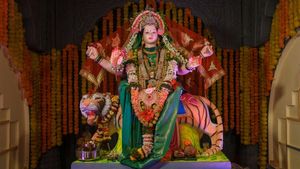 When Is Navratri In 2026? Full Dates, Rituals, Colours, Significance, and Fasting Guide
 -
 Vijay Sethupathi Confirms Maharaja 2, Hollywood Remake In The Works
 -
 Dashavatara Vrat 2026: Everything To Know About Tithi, Rituals, Fasting And The Ten Forms Of Lord Vishnu


Dhumavati Jayanti 2026: Everything About This Rare Mahavidya Festival And Its Significance

Dhumavati Jayanti is observed as the appearance day of Goddess Dhumavati, one of the ten Mahavidyas in Hindu tradition. Dhumavati Jayanti 2026 falls today on Monday, 22 June, during the Shukla Paksha Ashtami of the Jyeshtha month according to widely followed Panchang calculations.
Unlike many celebratory Hindu festivals, this day is approached with restraint and introspection. Worship is centred on understanding loss, detachment, and the deeper layers of human experience.
Dhumavati Jayanti 2026: Date And Tithi In 2026

In 2026, the observance aligns as follows:
- Date: 22 June 2026 (Monday)
- Tithi: Shukla Paksha Ashtami
- Month: Jyeshtha (Hindu lunar calendar)
While the date is consistently reported across major Panchang references, exact muhurat timings may vary slightly based on regional calculations.
Who Is Goddess Dhumavati
Goddess Dhumavati is known as the seventh Mahavidya in the Tantric tradition. She is associated with themes that are often avoided in conventional religious narratives-loss, separation, emptiness, and silence.
Her symbolism represents:
- The reality of impermanence
- The stripping away of illusion
- The state of detachment from material dependence
- Awareness that arises through difficult experiences
She is often described as a form that exists beyond comfort, pointing directly to truth without refinement or softness.
Spiritual Meaning Of Dhumavati Jayanti
Dhumavati Jayanti is not centred on prosperity rituals or festive celebration. The focus is internal.
Across traditions that observe the day, it is understood as a day to remind us of:
- Emotional detachment without denial of life
- Acceptance of uncertainty and loss
- Inner discipline through simplicity
- Reflection on what remains when attachments fall away
Dhumavati Jayanti 2026: Rituals And Observance Practices
Observance varies across regions and practitioners, but commonly includes simple and disciplined practices such as:
- Early morning purification and bathing
- Worship in a clean, uncluttered space
- Lighting a diya and incense
- Offerings like black sesame seeds, jaggery, or simple food items
- Chanting of Dhumavati mantras
- Silence or reduced speech during parts of the day
- Meditation focused on detachment and clarity
Some also include acts of charity or feeding those in need, reflecting the principle of letting go of ego-driven attachment.
Dhumavati Symbolism And Interpretation
Dhumavati's imagery is often stark, and that itself carries meaning. She is traditionally associated with the absence of adornment, which reflects a larger philosophical idea: truth does not depend on presentation.
Her presence in the Mahavidyas is significant because it expands the scope of divinity beyond joy and prosperity. It includes states that are uncomfortable but real-grief, isolation, and transition.
In many interpretations, she is not seen as a force of misfortune, but as a guide through phases where old structures of identity break down.
Dhumavati Jayanti 2026: Contemporary Relevance
In modern life, Dhumavati Jayanti is often approached more as a reflective observance than a ritual-heavy festival. Its relevance is frequently understood in terms of:
- Processing emotional transitions
- Understanding loss without avoidance
- Building resilience through acceptance
- Creating space for inner stillness
Dhumavati Jayanti 2026: What The Day Leaves Behind
Dhumavati Jayanti on 22 June 2026 carries a significant place within the Hindu spiritual calendar. It points toward acceptance of what is often left unspoken-loss, silence, and detachment.

 Continue with Google

