




 Click it and Unblock the Notifications


Latest Updates
-
 You Don't Need Surgery for Every Sinus Problem: When Is FESS Actually Necessary?
 -
 Who Was Mithu Mukherjee? Veteran Bengali Actress Passes Away At 71
 -
 Ahmedabad Police Flag Fraud Risk Behind Viral 'Rent A Garba Partner' Ads
 -
 Vidya Balan’s Jailer 2 Entry As Kantha: From Silk To Manjulika, A Look At Her Unconventional Roles
 -
 Samay Raina Has Now Denied Dating Rumours With Two Women In Three Months
 -
 Kareena Kapoor Turns 46: From Size Zero To Fine Lines, The ‘Daayra’ Actress Is Choosing To Age Without Apology
 -
 The Emotional Side of Delayed Parenthood That We Don’t Talk About Enough
 -
 World Alzheimer’s Day 2026: Why Early Diagnosis Matters And What This Year’s Theme Means
 -
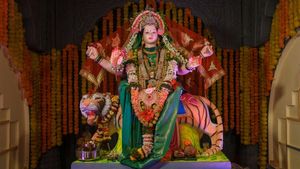 When Is Navratri In 2026? Full Dates, Rituals, Colours, Significance, and Fasting Guide
 -
 Vijay Sethupathi Confirms Maharaja 2, Hollywood Remake In The Works


The Conquest of Anga, Banga and Kalinga: BJP's Historic Sweep of Eastern India

The Puranas speak of three kingdoms born of a single blessing. When Sage Dirghatamas bestowed his grace upon the sons of King Bali, three powerful realms rose across eastern India - Anga, Banga, and Kalinga. On the morning of 4 May 2026, as counting tables across West Bengal delivered their verdict, that ancient geographical imagination returned to the centre of India's political conversation.

The Three Kingdoms and What They Meant
To understand the political significance of what has unfolded across eastern India over the past two years, one must first understand the land itself.
Anga, the eldest of the three kingdoms, corresponds to the heartland of present-day Bihar. In the Mahabharata, it was Anga that Duryodhana gifted to Karna to give him the royal standing he deserved - a kingdom considered peripheral to the Kuru heartland, yet proud enough to produce one of the epic's greatest warriors. Historically, the region formed the nucleus of the Mauryan empire and gave India some of its earliest urban civilisations.
Banga - the ancient name for the deltaic eastern territories now split between West Bengal and Bangladesh - was the realm where the Ganges fractures into a thousand veins before meeting the sea. It was a land of rice and rivers, of commerce and culture, producing the Bengali Renaissance and becoming the intellectual engine of colonial India. In the Mahabharata, the Banga king fought alongside the Pandavas, yet the region always retained a fierce independence - resisting absorption, rebuffing outsiders, and doing things emphatically on its own terms.
Kalinga, the coastal warrior kingdom of present-day Odisha, needs no introduction for anyone who has read Ashoka. It was Kalinga's resistance - and the rivers of blood that followed its conquest - that shook the Mauryan emperor into the arms of the Dharma. Kalinga's people were seafarers, temple-builders, and fighters. The region's spirit of self-determination has persisted into modern politics: for 24 continuous years, it resisted both the BJP and the Congress, choosing instead the regional anchor of Naveen Patnaik's Biju Janata Dal.
The Three Victories
Anga, Banga, Kalinga — These regions of Bharat were known for maritime trade, technology, and art. Together they formed a united, prosperous Eastern India.
— Kanchan Gupta 🇮🇳 (@KanchanGupta) May 4, 2026
The BJP is now in power in all three regions, signalling the resurgence of a New East with new hopes and new aspirations.…
In November 2025, the BJP-led NDA swept Bihar, securing 202 of 243 assembly seats and reducing the RJD-led opposition to just 35. For the first time, the BJP became the single largest party in the Bihar assembly. Anga was secured.
In Odisha, the story was equally decisive. The BJP ended 24 years of Biju Janata Dal rule, winning 78 seats in the 147-seat assembly. In the simultaneous Lok Sabha elections, the party won 20 of Odisha's 21 parliamentary seats. Kalinga had fallen - not to rivers of blood as in Ashoka's time, but to tribal outreach, development promises, and a sustained anti-incumbency wave.
Then came Banga. West Bengal voted on 23 and 29 April 2026, recording a historic turnout of 92.93% - the highest in the state's history. The election was hard-fought, shaped by battles over voter rolls, citizenship, identity, and 15 years of TMC rule. The results declared today mark the culmination of the BJP's most ambitious eastern project.
Why Anga, Banga, Kalinga Matters Beyond Political Scorecards
The BJP's political strategists have long understood that the party's dominance of the Hindi heartland - what classical texts called Aryavarta - needed to be complemented by a hold on the east. Historically, eastern India was considered distinct from the Aryan core: frontier kingdoms with their own cultural codes, their own epics, their own gods. Winning the East was never merely about seats in Parliament or state assemblies. It was about completing a civilisational narrative - about demonstrating that a pan-Indian political identity could hold from the Himalayas to the Bay of Bengal.
In the Mahabharata, the kings of Anga, Banga, and Kalinga fought on different sides of the Kurukshetra divide. They were powerful, proud, and ultimately absorbed into a larger story. The BJP's political project across eastern India mirrors that arc, drawing in regions that have historically resisted centralisation, and weaving them into a singular national narrative built around development, Hindutva, and the Modi brand.
Whether one regards this as unification or consolidation depends entirely on where one stands. But the geography is undeniable.

 Continue with Google

