




 Click it and Unblock the Notifications


Latest Updates
-
 October 2026 Festival Calendar: Pitru Paksha Ends, Navratri Begins, Dussehra Follows
 -
 Pitru Paksha 2026: What To Eat And Avoid, According To Astrologer Gauri Jain
 -
 Guide to Surviving Festive-Season Humidity While Hosting: An Expert Shares Tips on Choosing Fabrics
 -
 Is Your Makeup Causing Breakouts? A Dermatologist Explains
 -
 You Don't Need an MRI for Every Backache: What a Physiotherapist Looks For First
 -
 Who Is Tanya Mishra? The Model-Actress Fans Are Calling A National Crush
 -
 Happy Birthday Ranbir Kapoor: Inside 'Ramayana' Actor's ₹250 Crore Krishna Raj Home Built Around Kapoor Legacy
 -
 Kidney Transplant Rejection Can Be Silent. Here Is How Doctors Catch It
 -
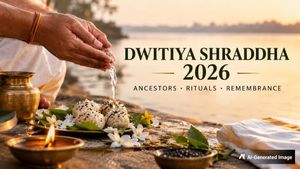 Dwitiya Shraddha 2026: What Makes This Pitru Paksha Day Significant For Honouring Departed Ancestors
 -
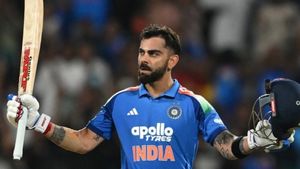 What Virat Kohli's 15,000 ODI Runs Reveal About Staying Fit After 35


PM Modi Hoists Tricolour At Red Fort In Fiery Red Bandhej Safa, Marks 80th Independence Day

The sun had barely cleared the ramparts of Red Fort on Saturday morning when the colour caught everyone's eye first: not saffron, not white, not green, but a deep, dotted red. Prime Minister Narendra Modi arrived to hoist the national flag on India's 80th Independence Day wearing a bright red Bandhani-print safa featuring yellow, green and white tie-dye patterns.

It was a small detail against the scale of the morning, with the 21-gun salute, the massed guard of honour and the crowds waiting below the ramparts, but for anyone who has followed Modi's Independence Day appearances since 2014, the turban was never really a small detail at all.
A Tradition That's Now Older Than Some Viewers Watching It
Since his first address from Red Fort in 2014, Modi's choice of colourful turbans has become a defining element of his annual Independence Day wardrobe, evolving from more than a visual statement into a running reflection of India's regional textiles, craftsmanship and cultural heritage. It's a tradition that has quietly outlasted several fashion cycles. This year it turned into a bit of a guessing game, with commentators openly speculating in the days leading up to 15 August about which print, which colour and which region's weave he would choose next.
This year's answer had a fittingly full-circle quality. Modi's very first Independence Day turban, back in 2014, was a bright red Jodhpuri bandhej finished with contrasting green accents. Twelve years on, red and bandhej returned, this time with a tricolour undertone running through the yellow, green and white patterning, a nod perhaps to the milestone the day itself represented.
From Leheriya To Saffron: A Decade Of Sartorial Choices
The years in between have taken Modi's stylists, or his own personal taste, depending on who you ask, through practically every classic Rajasthani tie and dye technique. 2015 brought a sunny yellow turban with a criss-cross of red and deep green. 2016 saw a pink and yellow bandhej with a long, dramatic trailing tail. 2017 mixed bright red and yellow with a subtle golden criss-cross woven through the fabric.
2022 aligned neatly with the Har Ghar Tiranga campaign, with a crisp white turban striped in saffron and green mirroring the flag itself. 2023 brought back classic Rajasthani bandhani in a multi-coloured palette of yellow, green and red, while 2024 leaned into leheriya again, this time in bold orange, dark green and yellow with a deeply pleated tail. Last year, for the 79th Independence Day, he went monochromatic, choosing an all-saffron safa paired with a saffron waistcoat and a tricolour stole.
Put side by side, the twelve turbans read almost like a visual timeline of Indian textile traditions: bandhani, leheriya, and Jodhpuri prints, each one, as commentators have noted, standing as a nod to the weavers and artisans of India.
More Than A Speech: A Record Setting Morning
The turban aside, Saturday's ceremony carried its own set of milestones. This was Modi's 13th Independence Day speech from the Red Fort ramparts, delivered on the 80th anniversary of India's independence. His addresses have grown steadily longer over the years. The 2025 speech ran to roughly 103 minutes, the longest Independence Day address by any Indian Prime Minister, after a 98-minute speech in 2024.
In his address this year, Modi urged citizens to "dream big" and "pledge big," saying that a nation moves forward on the strength of its dreams, resolve and capabilities, and that the world would see India differently once it becomes a developed nation. He pointed to India's shift over the past 12 years from being grouped among the "Fragile Five" economies to becoming the world's fastest-growing major economy, crediting the turnaround to the country's 140 crore citizens.
He also flagged a rare moment in the ceremony itself: Vande Mataram being played at the Red Fort on 15 August for what he said was the first time since Independence, coinciding with the 150th anniversary of the song's composition. On the economic front, he cited a 21-fold rise in railway coach production and a 33-fold increase in mobile phone manufacturing, alongside a hundredfold jump in digital transactions, and called for India to build up its energy security and nuclear power capacity.
Bottomline
Twelve years, twelve turbans, and a return, almost poetically, to where it all began. Saturday's red bandhej safa wasn't just a wardrobe choice. It closed a loop that started with a similar red bandhej back in 2014, on a morning that itself marked eight decades of Indian independence. Whatever else is remembered about the 80th Independence Day, the fabric on the ramparts once again did some of the talk.

 Continue with Google

