




 Click it and Unblock the Notifications


Latest Updates
-
 Can a 50-Year-Old Develop Alzheimer's? What Early-Onset Dementia Looks Like
 -
 Mahalaxmi Vrat 2026: Date, Puja Vidhi, And The Legend Behind The 16 Knots
 -
 Who Is Anant Nag? Meet The Veteran Kannada Actor Set To Receive Dadasaheb Phalke Award
 -
 Throwback Thursday: Kareena Kapoor’s ‘Poo’ To Priyanka Chopra’s ‘Desi Girl’, Bollywood Looks That Ruled 2000s
 -
 PM Narendra Modi Birthday Special: Make His Favourite Khichdi At Home And Know Its Health Benefits
 -
 PM Modi Turns 76: ‘Ashirwad Ka Diya’ To Be Lit At 500+ Locations Across India
 -
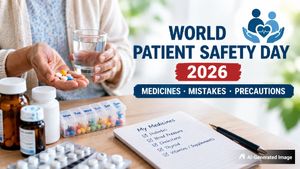 World Patient Safety Day 2026: Taking Multiple Medicines? Expert Explains How To Prevent Medication Errors
 -
 Kanya Sankranti 2026: Surya’s Virgo Transition, Rituals And Why The Day Is Spiritually Significant
 -
 Vishwakarma Puja 2026: Why Do We Worship Tools, Machines And Vehicles On This Day?
 -
 Grammy-Nominated Singer-Songwriter Alex Warren To Perform At Abu Dhabi Grand Prix 2026


Fiji's HIV Cases Have Risen 16-Fold Since 2019 — Now It's A National Emergency

Fiji's Minister for Health and Medical Services, Dr Antonio Lalabalavu, declared a national HIV emergency on Tuesday, September 15, 2026; an escalation from the HIV outbreak the government had first declared back in January 2025. Announcing the decision, Lalabalavu said the move recognised the epidemic's seriousness and the urgent, coordinated response the country now needed, adding plainly that an outbreak-level response was no longer sufficient.

The declaration comes as new government data lays bare the scale of the crisis facing the South Pacific nation of under a million people.
How Bad Has It Gotten?
The numbers behind Tuesday's declaration are stark. According to figures released by Fiji's health ministry, one in every 60 adults in the country is now living with HIV, a sharp jump from one in 167 just five years ago. In 2025 alone, 2,016 people were newly diagnosed with the virus, a 27 per cent rise on the previous year and roughly 16 times more diagnoses than were recorded in 2019.
The Joint United Nations Programme on HIV/AIDS (UNAIDS) puts the scale in even starker terms, estimating that new HIV infections in Fiji have risen 12-fold over the past 15 years, and that around 9,000 people in the country were living with HIV as of 2025. Perhaps most concerning, UNAIDS figures show only 39 per cent of people with HIV in Fiji currently know their status, and just 22 per cent are receiving antiretroviral treatment, meaning a large share of cases are likely going undetected and untreated.
Lalabalavu was careful to note that part of the rise reflects better detection rather than a runaway epidemic alone. As testing has expanded, he said, more people living with HIV have simply been identified, though he added that this doesn't take away from the genuine seriousness the data reveals.
For context, Fiji's current rate, while alarming for the Pacific region, still sits below the world's worst-affected areas: the World Health Organization estimates nearly one in 35 adults live with HIV in parts of Africa.
What's Driving The Surge

Much of Fiji's outbreak has been linked to injecting drug use, and a needle shortage appears to have made the problem worse rather than better. Jason Mitchell, who chairs Fiji's National HIV Outbreak Response, has pointed to a scarcity of clean needles in the country, tied partly to legal restrictions that discourage people from carrying injecting equipment.
That concern was echoed in a rapid assessment commissioned by the WHO and UNDP and conducted by the Kirby Institute, which involved interviews with 56 people who inject drugs and consultations with 50 stakeholders. The assessment recommended the urgent rollout of needle and syringe programs, pointing to global evidence that such programs are effective at preventing both HIV and hepatitis transmission.
What The Government Is Doing About It
Under the new emergency footing, Fiji says it will expand several services nationwide:
- Free HIV testing with on-the-spot results, available across the country
- Free PrEP (pre-exposure prophylaxis) for people at higher risk of contracting HIV
- Free needles for people who inject drugs, as part of a new needle and syringe program
- Free antiretroviral treatment for anyone who tests positive
- A five-minister cabinet subcommittee, set up specifically to remove barriers slowing down the response
The government has also stated clearly that discrimination against people living with HIV is illegal, and that these services are being made available nationwide rather than concentrated in urban centres alone.
The response builds on Fiji's existing HIV Surge Strategy (2024-2027) and national HIV Outbreak Response Plan, developed with the WHO, UNDP, UNAIDS and UNFPA, which had already been working to expand testing, treatment and harm reduction outreach before this week's escalation.
Disclaimer: The information provided in this article is for general informational and educational purposes only and is not intended as a substitute for professional medical advice, diagnosis, or treatment. Always seek the advice of your physician or a qualified healthcare provider with any questions you may have regarding a medical condition.

 Continue with Google

