




 Click it and Unblock the Notifications


Latest Updates
-
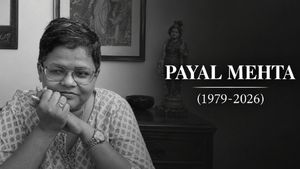 Senior Journalist Payal Mehta Passes Away At 46; PM Modi, Rahul Gandhi, Other Political Leaders Pay Tributes
 -
 Alia Bhatt’s Ganesh Chaturthi 2026 Looks Were All About Custom Kurtas, Colour And Modern Festive Style
 -
 Weekend Read: Salman Khan Goes Shirtless on BB 20, Gives Trolls a Befitting 'Come Troll Me' Reply
 -
 World Cleanup Day 2026: Why ‘Clean Plates’ Could Be The Secret To Cleaner, Greener Cities
 -
 Deepika Padukone Welcomes Second Daughter With Ranveer Singh, A Day After Siddhivinayak Temple Visit
 -
 Penelope Cruz Steps Onto The TIFF Red Carpet In A Statement High Jewellery Look
 -
 Raaka Teaser: Allu Arjun And Atlee’s ₹1,000 Crore Sci-Fi Epic Gets A Cryptic Global Triumph Tease
 -
 Nita Ambani’s Amrapali Bharatam Necklace For Ganesh Chaturthi Has An Interesting Connection To Sonam Kapoor
 -
 Oscars 2027: ‘Gondhal’ Selected As India’s Entry, ‘Dhurandhar’ Among Major Films That Missed The Cut
 -
 Ruokamill Protein For Women: Honest Review, Health Benefits And Best Time to Take It


Upanishads-The Bedrock of Indian Culture(Upanishads And Indian Symbols)


The Vedanta Kesari, p. 583-587, December 2007
Symbols have a history, too. One does not invent them overnight. In the Indian context, one can trace most of our religious symbols to the Upanishads. The greatest of symbols that permeates the Indian literature and thinking is OM. Says the Mandukya Upanishads (verse 1) OM is this imperishable Word. OM is the Universe, and this is the exposition of OM. The past, the present and the future, all that was, all that is, all that will be, is OM. Likewise all else that may exist beyond the bounds of Time, that too is OM.
OM represents the Ultimate Truth. As is clear from this verse, it is God which assumes all forms.
There is a popular belief in the 'educated" Indian mind today that 'idol" worship or worship of forms has no sanction in the Vedas or the Upanishads and that this is a later contribution which crept into classical Hinduism through the influence of Buddhism or Puranic literature. On the contrary, the Upanishadic vision of oneness of the Ultimate Reality and its manifestation in infinitely different forms is the very basis of image worship in India. Brahma, Vishnu, Shiva, Devi, Ganesha and Kartikeya are all different forms of the same Reality.
The proverbial Indian tolerance of differing world-views is also a direct offshoot of this perception of unity in diversity.
The Omkara is the central Indian symbol which has its origin in the Vedas and the Upanishads and which has been accepted as a primary symbol in other Indian religions also like Buddhism, Sikhism and Jainism. In fine, the imprint of the Upanishads on Indian culture is all-pervasive. If one carefully studies, one can easily see how the Indian culture has its roots in the Upanishads. Indian culture and the Upanishads are inseparable. The more we study these wonderful texts, the better will be our understanding of Indian culture and society. The role of Indian Civilization in the future world will be determined by how closely our polity is guided by the philosophy of the Upanishads.

 Continue with Google

