




 Click it and Unblock the Notifications


Latest Updates
-
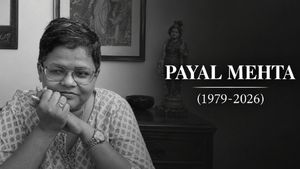 Senior Journalist Payal Mehta Passes Away At 46; PM Modi, Rahul Gandhi, Other Political Leaders Pay Tributes
 -
 Alia Bhatt’s Ganesh Chaturthi 2026 Looks Were All About Custom Kurtas, Colour And Modern Festive Style
 -
 Weekend Read: Salman Khan Goes Shirtless on BB 20, Gives Trolls a Befitting 'Come Troll Me' Reply
 -
 World Cleanup Day 2026: Why ‘Clean Plates’ Could Be The Secret To Cleaner, Greener Cities
 -
 Deepika Padukone Welcomes Second Daughter With Ranveer Singh, A Day After Siddhivinayak Temple Visit
 -
 Penelope Cruz Steps Onto The TIFF Red Carpet In A Statement High Jewellery Look
 -
 Raaka Teaser: Allu Arjun And Atlee’s ₹1,000 Crore Sci-Fi Epic Gets A Cryptic Global Triumph Tease
 -
 Nita Ambani’s Amrapali Bharatam Necklace For Ganesh Chaturthi Has An Interesting Connection To Sonam Kapoor
 -
 Oscars 2027: ‘Gondhal’ Selected As India’s Entry, ‘Dhurandhar’ Among Major Films That Missed The Cut
 -
 Ruokamill Protein For Women: Honest Review, Health Benefits And Best Time to Take It


Gnosis And Inspirations Of Upanishads


By means of the Higher Knowledge the wise behold everywhere Brahman, That otherwise cannot be seen or seized, That has no comparisons, no eyes or ears, no hands or feet; That is Eternal and Omnipresent, All-Pervading and Extremely Subtle; That is Imperishable and The Source of All Beings. - Mundaka Upanishad
The pure Brahman alone exists. That immutable Reality is the meaning of "That". There is no likeness of Him. His name is Great Glory (Mahad Yasah). His form is not an object of vision; no one beholds Him with the eyes. They who, through pure intellect and the Knowledge of Unity based upon reflection, realise Him as abiding in the heart become immortal. - Svetasvatara Upanishad
Om. Infinite is That Brahman, infinite in this manifested universe. From the Infinite Brahman proceeds the infinite. After the realization of the Great Identity, after the cosmic dissolution, when the infinity of the infinite universe merges in the Infinite Brahman, there remains the Infinite Brahman alone. - Brihadaranyaka Upanishad
The wise man beholds all beings in the Self, and the Self in all beings; for that reason he does not hate anyone. To the seer, all things have verily become the Self: what delusion, what sorrow, can there be for him who beholds that Oneness? - Isa Upanishad
When all the desires that dwell in the heart fall away, then the mortal becomes immortal and here attains Brahman. When all the ties of the heart are severed here on earth, then the mortal becomes immortal. This much alone is the teaching. - Katha Upanishad
English translation by Swami Nikhilananda with minor modifications.
The esoteric scripture of Hindusim, Upanishad can be translated from the sanskrit as upa-ni-shad, coming from the verb sad - to sit with, and upa - at the feet of a master. Upanishads are oral teachings, realization and gnosis transmitted by the gnostics, yogi masters and mystics. They primarily discuss philosophy, meditation, and the nature of God; they form the core spiritual thought of Vedantic Hinduism. Considered as mystic or spiritual contemplations of the Vedas, their putative end and essence, the Upanishads are known as Vedānta ("the end/culmination of the Vedas"). There are at least 108 Upanishads, each of different length. If collected in one volume, they would be approximately the combined size of the Judaic and Christian Testaments. Composed over a span of more than 1500 years, the oldest is dated between 800 and 400 b.c.e., the youngest from the Middle Ages.

 Continue with Google

