




 Click it and Unblock the Notifications


Latest Updates
-
 The Sepsis Clock: Why Waiting to See If the Fever Settles Can Be Dangerous
 -
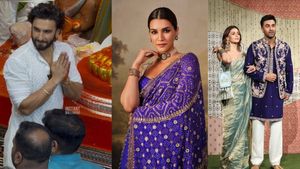 Ganesh Chaturthi 2026: Inside The Star-Studded Celebrations At Lalbaugcha Raja And Antilia
 -
 The 5-Minute Childhood Skincare Routine: Why Simpler May Actually Be Better
 -
 OTT Releases This Week (September 14–20): What To Watch Across Netflix, Prime Video, JioHotstar And More
 -
 Fiji's HIV Cases Have Risen 16-Fold Since 2019 — Now It's A National Emergency
 -
 Can a 50-Year-Old Develop Alzheimer's? What Early-Onset Dementia Looks Like
 -
 Mahalaxmi Vrat 2026: Date, Puja Vidhi, And The Legend Behind The 16 Knots
 -
 Who Is Anant Nag? Meet The Veteran Kannada Actor Set To Receive Dadasaheb Phalke Award
 -
 Monsoon And Diabetes: Why Infection Risk Increases During The Rainy Season
 -
 Throwback Thursday: Kareena Kapoor’s ‘Poo’ To Priyanka Chopra’s ‘Desi Girl’, Bollywood Looks That Ruled 2000s


Unmasking Our Identity (Contd)


The Vedanta Kesari, p. 326-329, September 2007
Whether or not a person is provided with an I-Card (identity card), everyone has his or her own unique identity. The process of creating our identity seems to begin with the issue of our birth-certificate which provides the names of our parents as also the date and place of our birth. Then comes our 'name', chosen with much care and interest by elders reflecting their vision of child's future personality. One's family and caste also play a role in the naming process. Later, when we join the school, right from the junior classes onwards, we are issued an I-Card, given a roll number and we begin to become possessive about our identity.
Nicknames that others give us also become part of our self-identification (about some of our buddies, all that we remember about them is their nick-name, and not the 'real' name!). With the passage of time, as we go on gathering our certificates of achievements in academic field or in sports or music or drama or any other extra-curricular activities, we reinforce our 'identity'. We generally take pride in it but at times also feel bad for either our bad performance in some field or for not acquiring some certificate which others have and we have missed.
Our identity is, thus, based on our nationality, language, hierarchy of caste and so on. The work we do and the experience we gain through it also add to our identity. If one is employed in a company, one also gets one's employee-number, his bank-account number, his insurance number and so on. A businessman may require another identity in the form of a license to carry out his business under a name. When we are admitted to a hospital or visit a doctor, there too we get a patient-number. When we buy a computer, we are given a customer-number and if we have an Internet account, we add another tag—our email id. There is no end to our identities.
The process of creating an identity for oneself does not end here. Our relationships with others also add to our sense of identity. First we have a 'child' identity, then we acquire a boy or a girl identity. Adulthood offers different sets of identities: a father or a mother, or a brother-in-law or maternal uncle or paternal aunt or a grandpa or a granny. There are also identities based on our relationship with our province or the town we live in (like Chinese, Assamese, Bengali and so on).
Our experiences in life also add to our identity. A person who goes on encountering failures in life, develops a 'loser' identity, while a person who goes on tasting success, gains a 'winner' identity. These experiences in turn generate inferiority or superiority complexes.
About the author
Swami Atmashraddananda
Swami Atmashraddhananda is a monk of the Ramakrishna Order and editor of The Vedanta Kesari from the year 2004 .

 Continue with Google

