




 Click it and Unblock the Notifications


Latest Updates
-
 Ahmedabad Police Flag Fraud Risk Behind Viral 'Rent A Garba Partner' Ads
 -
 Vidya Balan’s Jailer 2 Entry As Kantha: From Silk To Manjulika, A Look At Her Unconventional Roles
 -
 Samay Raina Has Now Denied Dating Rumours With Two Women In Three Months
 -
 Kareena Kapoor Turns 46: From Size Zero To Fine Lines, The ‘Daayra’ Actress Is Choosing To Age Without Apology
 -
 The Emotional Side of Delayed Parenthood That We Don’t Talk About Enough
 -
 World Alzheimer’s Day 2026: Why Early Diagnosis Matters And What This Year’s Theme Means
 -
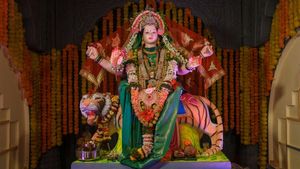 When Is Navratri In 2026? Full Dates, Rituals, Colours, Significance, and Fasting Guide
 -
 Vijay Sethupathi Confirms Maharaja 2, Hollywood Remake In The Works
 -
 Dashavatara Vrat 2026: Everything To Know About Tithi, Rituals, Fasting And The Ten Forms Of Lord Vishnu
 -
 Senior Journalist Payal Mehta Passes Away At 46; PM Modi, Rahul Gandhi, Other Political Leaders Pay Tributes


Do We Need Religion?-Part II


What is Religion?
Let us begin with the meaning of the word. Etymologically, the word 'religion' comes from the Latin word 'religio" which means 'that which unites". Those that argue that religion, in the sense of institutionalised religion, is a divisive force in society are often startled when they first learn the etymological origin of the word. It sounds almost contradictory to common sense. And yet, that is what the word means. This is the case, not only in English, but in Sanskrit as well. The word dharma means that 'which holds together" or 'which unifies".
This is captured in the final hymn of the Rig Veda, one of the most ancient scriptures of the world:
Sam gacchadvam, sam vadhadvam
sam vo manamsi janatam
deva bhagam yatha purve, sam janana upasate
samano mantrah, samiti samani
samanam manah saha cittamesam
samanam mantramabhi mantraye vah
samanena havisa juhomi
samani va akutih samana hridayani vah
samanamastu vo mano yatha vah susahasati.
'Be united, Speak in harmony, Let your minds apprehend alike, Common be your prayer; Common be the end of your assembly; Common be your resolution; Common be your deliberations. Alike be your feelings; United be your hearts; Common be your intentions; Perfect be your unity."
Let us analyze this a little further. What is it that we are trying to unite? Again, at first we are tempted to think of society, communities, nations and so on. However, social unity, communal unity and national unity are just one aspect. There are actually three dimensions of unity. The first dimension is unity within us. The second is social or interpersonal unity, which is unity with beings and things. The third is unity with Ultimate Reality. Let us discuss each of these in turn.
1. Unity within Ourselves
The human being has various faculties, the functioning of which is not always in harmony. We think in one way, act in another, speak in yet another and feel in another way. For example, we may intellectually accept social equality, but in practice we might be quite sectarian. If it is pointed out to us, we will be surprised and offer some innocuous explanation for our behaviour because we do not regard ourselves as prejudiced or sectarian. In fact, it is an unresolved conflict within. Unity within ourselves means to resolve these kinds of conflicts, including those that we are aware of and those that we are not yet aware of.
2. Unity with Beings and Things
The majority of our time is spent in interpersonal relationships. We act and react on each other throughout the day. If those relationships are not harmonious, we will feel disturbed and will not have peace of mind. Such a state of mind is not something that can be sustained for long without having a harmful effect on the entire personality. Unity with beings and things means to act in a way that is harmonious and constructive.
In this context arises the concept of ethics and values. Religion is often associated with ethical conduct, as it should be. The foundation of ethics is to act based on the awareness of unity.
Read about unity with the ultimate on the Next Page
About the author
The author is a Professor of Mathematics and Chair of the Department of Mathematical and Computational Sciences at the University of Toronto. He gives regular lessons to young students' group attached to the Vedanta Society of Toronto.

 Continue with Google

