




 Click it and Unblock the Notifications


Latest Updates
-
 Everyone's Talking About Rahane's Igatpuri Home. Here's Why The Town Itself Is Worth The Trip
 -
 You Don't Need Surgery for Every Sinus Problem: When Is FESS Actually Necessary?
 -
 Who Was Mithu Mukherjee? Veteran Bengali Actress Passes Away At 71
 -
 Ahmedabad Police Flag Fraud Risk Behind Viral 'Rent A Garba Partner' Ads
 -
 Vidya Balan’s Jailer 2 Entry As Kantha: From Silk To Manjulika, A Look At Her Unconventional Roles
 -
 Samay Raina Has Now Denied Dating Rumours With Two Women In Three Months
 -
 Kareena Kapoor Turns 46: From Size Zero To Fine Lines, The ‘Daayra’ Actress Is Choosing To Age Without Apology
 -
 The Emotional Side of Delayed Parenthood That We Don’t Talk About Enough
 -
 World Alzheimer’s Day 2026: Why Early Diagnosis Matters And What This Year’s Theme Means
 -
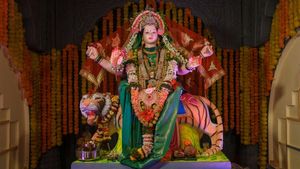 When Is Navratri In 2026? Full Dates, Rituals, Colours, Significance, and Fasting Guide


The Eternal Message Of The Gita-The Non-Manifested III


What discipline, then, is one to follow in order to attain to this supreme Non-manifested? Sri Krishna shows it to us in the 13th chapter, where He speaks at length about the 'field' (kshetra) and the 'Knower of the field' (kshetrajna) (cf. chapter V with the commentary on verse 13.2). The akshara is attained when the higher buddhi is awakened and the edifice of our mental structure collapses.
As long as this mental structure prevails, all our experiences are interpreted in terms of concepts (time, space and causality) and divided into various categories. Thus we create the notions of waking, dream and deep sleep. But, if we look at our experience of the manifested and the non-manifested in its intrinsic aspect, we find that it concerns a Totality (sarvam) and not a totalistic of different elements.
Whereas the non-manifested (avyakta) spoken of in verse 8.18, is opposed to the manifested (vyakta). The Non-manifested (akshara) of verse 8. 20 (the non-manifested of which Ramana Maharshi speaks) is the intuition of the One who is without any opposite, who cannot give any hold to our attempts at fragmentation. When the ego (being the outcome of ignorance) establishes a subject-object rapport within a space-time reality, it finds the indivisible All apparently divided into past, present and future, and into innumerable parts: 'Indivisible, He dwells in all beings as if He were divided. He is what supports all beings; He destroys them and gives birth to them' (Gita, XIII. 16). But, in fact, the Reality cannot be fragmented, and the different states which we think to be passing through in the course of our lives, are not really distinct from one another. These, the Mandukya Upanishad says, do not appear as the four feet of a cow, but as one and the same coin that has been artificially divided into several parts (see Shankara's commentary on the 2nd mantra of the Mandukya Upanishad).
Indeed, whatever the divisions which the number 'one' may be subject to, it will always be enlisted with the numerator, for 'one' cannot be fragmented. (This 'one' who is not admitted into any one series, who is not the 'one' that is normally followed by 2, 3, 4, etc., corresponds to the intuition that we may have of the non-duality [advaita] inherent in each experience.) This intuition is a direct knowledge without any mental processing, infinitely more real than the sensory experience. Sri Ramakrishna, to whom Narendra (the later Swami Vivekananda) put the question: 'Have you seen God?', replied: 'I see God more clearly than I see you.' This God is the akshara, the non-manifested of which Ramana Maharshi was said to be conscious of. But here, as one may expect, it concerns an impersonal comprehension that does not admit of a perceiver nor of an object perceived.
Gaudapada and Shankara endeavour to take us to that comprehension by demonstrating that all that which is perceived-the spectacle-is unreal (Mandukya Karika, II. 4). On the other hand, that which is not perceived is the Real, the spectator who is eternally present. It may seem paradoxical and even absurd to enunciate such a proposition: 'What is perceived is unreal, and what is not perceived is real.' By 'what is not perceived' one should understand 'That which cannot be perceived in any way'. The objection which brings in the classic examples of unreality such as 'the horns of a hare' etc., claiming that this line of reasoning would accord reality to these horns, because one doesn't perceive them, would be void: The very fact of their being conceived is enough to deprive them of all reality, for a concept, too, is an idea that is perceived.
About the author
A monk of the Ramakrishna Order, India, Swami Siddheswarananda (1897-1957) taught Vedanta in Europe in the 1940s as the Minister-in-Charge of Centre Vedantique Ramakrichna, Gretz, France. This is the fourth installment of a series of about a dozen articles on various themes of the Gita-teachings based on his notes.
Chat With The Devotees Of Ramakrishna Paramahamsa

 Continue with Google

