




 Click it and Unblock the Notifications


Latest Updates
-
 You Don't Need Surgery for Every Sinus Problem: When Is FESS Actually Necessary?
 -
 Who Was Mithu Mukherjee? Veteran Bengali Actress Passes Away At 71
 -
 Ahmedabad Police Flag Fraud Risk Behind Viral 'Rent A Garba Partner' Ads
 -
 Vidya Balan’s Jailer 2 Entry As Kantha: From Silk To Manjulika, A Look At Her Unconventional Roles
 -
 Samay Raina Has Now Denied Dating Rumours With Two Women In Three Months
 -
 Kareena Kapoor Turns 46: From Size Zero To Fine Lines, The ‘Daayra’ Actress Is Choosing To Age Without Apology
 -
 The Emotional Side of Delayed Parenthood That We Don’t Talk About Enough
 -
 World Alzheimer’s Day 2026: Why Early Diagnosis Matters And What This Year’s Theme Means
 -
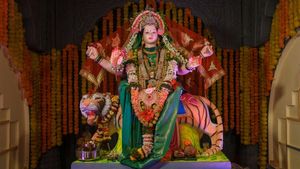 When Is Navratri In 2026? Full Dates, Rituals, Colours, Significance, and Fasting Guide
 -
 Vijay Sethupathi Confirms Maharaja 2, Hollywood Remake In The Works


Kishangarh Painting, Art Inspired by Religion of Love - II


Kishangarh art is only concerned with the realities of life; above all, with passionate love service, conceived as the symbol of all union. Rajput art creates a magic world where all men are heroic, all women are beautiful, passionate and shy, beast both wild and tame are friends of man and trees and flowers are conscious of the footsteps of the bridegroom as he passes by. This magic world is not unreal or fanciful, but a world of imagination and eternity, visible to all who do not refuse to see with the transfiguring eyes of love."
When al-Biruni, the famous Muslim polymath, the first anthropologist and Islamic scholar came to India in 1017 AD, the religion of the people of India was mostly Vaishnava. Eleventh century witnessed a great rise of Vaishnavite philosophy that taught that way to peace and happiness is through Bhakti (loving devotion) and that Bhakti is only to be obtained through grace. At the close to twelfth century, the famous Bengali poet Jayadeva wrote Gita Govinda on the love of Radha Krishna, a celestial love affair in human kingdom. In this period the devotion school of Radha Krishna became the religion of love.
By the middle of thirteenth century Islam was firmly established in India and during this time forward Sufism influenced Hinduism greatly. The Sufi position of union with God through devotional love was seen a mirror reflection and complementary to the devotion of Krishna in Vaishnavite sect of Hinduism. Vedantic idea of Oneness found its appreciation in the Supreme Oneness of Allah and Islam's teachings.
The Sufi way of inducing mystic ecstasy such as music, poetry and recitation of the sacred name of God were adopted by Chaitanya (1486-1533), the prophet of Vaishnavism in Bengal. According to Chaitanya, God or Krishna who is the representation of God on earth is the lover and the soul of man is his bride represented by Radha, For describing the stages of Radha's love for Krishna, the analogy of human love was adapted.
The first stage is the awakening of love. The next is the meeting of lovers, followed by Sambhoga or union. Then comes grief in separation, symbolized by the anguish suffered by the Gopis of Vrindavana when Krishna goes to Mathura. Finally comes Bhavasammilana or spiritual marriage.
Chaitanya comes to the realization that love is the supreme regulating principle of the universe. The universe is a poem, and the spiritual soul alone is privileged to reap its deep poetry.

 Continue with Google

