




 Click it and Unblock the Notifications


Latest Updates
-
 Independence Day 2026: 10 Must-Try Dining Experiences With Family And Friends — Tricolour Buffets To Brunches
 -
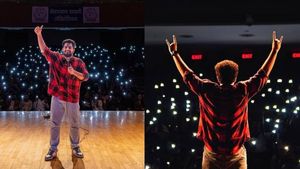 Samay Raina's FIRs Are Quashed: How Fundraising For Persons With Disabilities Bought Him Legal Freedom
 -
 Independence Day 2026: Why Did Gandhi Stay Away From Independence Day Celebrations?
 -
 A New Organ, A New Beginning: How Transplantation Changes Careers, Relationships And Family Life
 -
 Pregnancy Skin Changes: What’s Normal and What Needs a Dermatologist?
 -
 Independence Day 2026: How ‘Vande Mataram’ And Yuva Shakti Are Taking Centre Stage At The Red Fort Ceremony
 -
 The Emotional Cost of Being Available 24/7: Why Many Professionals Can't Switch Off
 -
 Hariyali Teej 2026: From Swings To Peacocks, 7 Beautiful Mehndi Designs To Try This Festival
 -
 Independence Day 2026: Before Har Ghar Tiranga, Flying Your Flag Was Illegal
 -
 Independence Day 2026: Is India Celebrating Its 79th Or 80th Year Of Freedom?


Who watches the watchers?

CHICAGO, Feb 5 (Reuters) In some cities in Europe and the United States, a person can be videotaped by surveillance cameras hundreds of times a day, and it's safe to say that most of the time no one is actually watching.
But the advent of ''intelligent video'' -- software that raises the alarm if something on camera appears amiss -- means Big Brother will soon be able to keep a more constant watch, a prospect that is sure to heighten privacy concerns.
Combining motion detection technology with the learning capabilities of video game software, these new systems can detect people loitering, walking in circles or leaving a package.
New microphone technology can isolate the sound of a gunshot and direct the attached camera to swivel and zoom in on the source.
Sensitivity may reach the point where microphones could pick out the word ''explosives'' spoken in a crowd.
''There's just not enough personnel to watch every single camera,'' said Chicago emergency operations chief Andrew Velasquez.
''We are piloting analytic software right now ... where you can set that particular camera to watch for erratic behavior, or someone leaving a suitcase on the sidewalk.'' Since the attacks on the United States of September 11, 2001, sections of New York, Washington, Los Angeles, Chicago and even a few smaller US towns have been blanketed with closed-circuit cameras. Privately owned cameras are also proliferating.
FALSE POSITIVES The encroachment on privacy in what civil libertarians call a ''surveillance society'' may be a price willingly paid by citizens who fear terrorism and crime.
But ever-alert software capable of maintaining a continuous ''watch'' on security cameras multiplies the risks of harassing innocent people, privacy experts say.
''I don't buy it. The number of false positives are going to be astronomical,'' said David Holtzman, author of ''Privacy Lost.'' ''It's extremely dangerous to abrogate legitimate law enforcement authority ... to a camera.'' In Chicago's darkened, windowless surveillance center, Velasquez looks forward to using new technology, which has had some success elsewhere.
The port of Jacksonville, Florida, has dispensed with human monitoring of cameras altogether by sending alerts and live video to the personal digital assistant of the nearest officer on patrol, according to a spokesman for ObjectView Inc.
ObjectView is one of two dozen companies seeking to perfect so-called intelligent video -- an industry whose sales will grow from 60 million dollars to 400 million dollars within five years, according to global consulting group Frost & Sullivan.
Meanwhile, Texas is evaluating a pilot program in which it allowed Internet access to video of unmanned sections of its border with Mexico and urged viewers to send an e-mail if they spotted something.
''The cameras don't replace police officers. They are in essence a force multiplier. They serve as an extra set of eyes,'' Velasquez said.

 Continue with Google