




 Click it and Unblock the Notifications


Latest Updates
-
 Who Is Adarsh Balak? The 1970s Indian Poster Boy On The London Runway
 -
 Hurun India Rich List 2026: Who Are India's 10 Richest And How Much Are They Worth?
 -
 Who Is Jay Singh Rathore? The X User Accused Over A Rs 1.5 Lakh Appeal
 -
 Eye Injury at Home: The Common Things Parents Should Never Put in a Child's Eye
 -
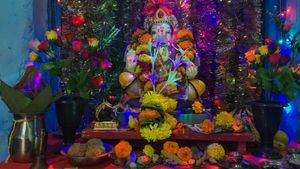 Ganesh Visarjan 2026: What To Do With Puja Flowers And Nirmalya
 -
 Condoms, Pills, Copper-T or Hormonal IUD: Expert Answers How Do You Actually Choose?
 -
 The Missing Medal: How Mirabai Chanu Finally Completed Her Collection At The Asian Games
 -
 From Corsetry To Crystals: Breaking Down Rashmika Mandanna's Vogue World Gown
 -
 Govt Warns Against Overusing Antibiotics And Painkillers: No Prescription, No Pills
 -
 72nd National Film Awards: Yami Gautam's Message For Outsiders, Mammootty And Dhanush Honoured


Kishangarh Painting, Art Inspired by Religion of Love


A great art was born in the wake of Buddhism. The cave temples of Ajanta were decorated with paintings of sublime beauty. In Central Asia, China and Japan, Buddhism sparked a great art movement which inspired the construction of beautiful pagodas, gardens of peace and calm, poetry and painting. In Java, Buddhism inspired the construction of the greatest sculpture gallery of the world, the temple of Borobuddhur.
The inspiration of Islam gave birth to the noble mosques of Cordoba, Cairo, Baghdad and Isfahan. Their graceful domes and minarets decorated with tiles of great beauty, commune with heaven and indicate how love for beauty burst out, even from an austere faith which forbade sculpture and painting (when made for worship purpose).
Christianity inspired the sublime architecture of the Gothic cathedrals of Chartres, Amiens, Rhiems and Milan, and the great paintings of Leonardo da Vinci, Raphael, Giotto and Coreggio.
Similarly the beautiful religion of Love in India, that is the cult of Sri Krishna as well as Sufi influences inspired the great paintings of Kishangarh.
Founded in 1597, the town of Kishnagarh is famous for its finest school of miniature paintings in the 18th century. Kishnagarh is only 27km away from Ajmer which is the famous town where the celebrated Sufi saint Khwaja Mu'inuddin Chishti's body is laid to final rest and hence a sacred site of pilgrimage. What makes the miniature paintings of Kishangarh distinct is that they are specially influenced by two Religious School of Love: Vaishnavite and Sufism.
According to many historians, Indian paintings began in the caves of Ajanta and evolved into the Pala and Jain styles. During early sixteenth century the Persian infusion came into play. Under the patronage of Akbar there was a true cultural cross-fertilization between the Persian techniques and India tradition, and a style of painting known as Mughal, which is truly Indian in spirit, evolved.
The beauty of Rajput paintings (Kishnagarh belongs to such school) is greatly inspired by the love of Radha, Krishna and the mythical human lover between them transcend itself to become divine love.
A. K. Coomaraswamy, mystic, scholar and historian while commenting on Kishangarh painting wrote: "Such paintings must always intimately appeal to those who are attracted by Indian life and thought, and above all to those who realize that they form the last visual records of an order that is rapidly passing away never to return.

 Continue with Google

