




 Click it and Unblock the Notifications


Latest Updates
-
 October 2026 Festival Calendar: Pitru Paksha Ends, Navratri Begins, Dussehra Follows
 -
 Pitru Paksha 2026: What To Eat And Avoid, According To Astrologer Gauri Jain
 -
 Guide to Surviving Festive-Season Humidity While Hosting: An Expert Shares Tips on Choosing Fabrics
 -
 Is Your Makeup Causing Breakouts? A Dermatologist Explains
 -
 You Don't Need an MRI for Every Backache: What a Physiotherapist Looks For First
 -
 Who Is Tanya Mishra? The Model-Actress Fans Are Calling A National Crush
 -
 Happy Birthday Ranbir Kapoor: Inside 'Ramayana' Actor's ₹250 Crore Krishna Raj Home Built Around Kapoor Legacy
 -
 Kidney Transplant Rejection Can Be Silent. Here Is How Doctors Catch It
 -
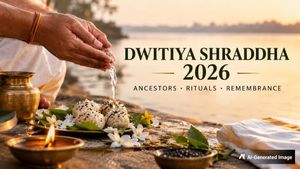 Dwitiya Shraddha 2026: What Makes This Pitru Paksha Day Significant For Honouring Departed Ancestors
 -
 What Virat Kohli's 15,000 ODI Runs Reveal About Staying Fit After 35


Born On a Lotus, Claimed By All: The Story Behind Kabirdas Jayanti 2026

A weavers' colony on the banks of the Ganga. A child said to have appeared on a lotus flower in the Lahartara pond. A saint no religion could fully claim in life - or in death. The story of Kabir Das is unlike any other in Indian spiritual history, and every year, on the full moon night of the Hindu month of Jyeshtha, the country pauses to remember him.

Kabirdas Jayanti 2026 falls on Monday, 29 June, marking what would be the 649th birth anniversary of the revered poet-saint. It is a day observed not just with religious fervour but with something rarer - genuine reflection on how one person's words can survive six centuries.
When History Becomes Uncertain
Kabir was born in 1398 in the vibrant city of Varanasi, Uttar Pradesh, on a full moon day in the Hindu month of Jyeshtha. Beyond that, history grows murky - and the mystery only deepens his legend.
Some scholars believe that with the blessings of his Guru Ramanand, he was born of a widow Brahmin woman who, fearing social shame, left the infant near the Lahartara pond in Kashi. He was then raised by a weaver named Neeru and Neema who happened to pass by. Others hold that Kabir Das was born to Muslim parents but studied under a Hindu guru, yet ultimately eluded classification as either Muslim or Hindu.
He called himself both son of Allah and son of Ram. Neither community could box him in.
The Weaver Who Wove Words

Kabir never sought the comfort of a throne or an ashram. Unlike other Gurus and Saints of his time, Kabir lived simply as a weaver. He married and had children, grounding his spiritual journey in the realities of daily life.
It was this ordinariness that made his poetry extraordinary. His dohas - the two-line couplets that became his signature - were not written for scholars. They carried messages of love, humanity, devotion, and social equality in language so simple that anyone could understand them. They still appear in school textbooks across India. They still circulate on WhatsApp. They still sting.
Kabir's sharp criticism of certain religious practices stirred controversy during his lifetime, making him a polarising figure. He attacked the caste system, idol worship, and the hollow rituals practised in both temples and mosques. Nobody was spared. No institution was sacred.
What Happens When He Died - And Why It Matters
The legend of Kabir's death is, in many ways, the most telling part of his story.
It is said that when Kabir died, his followers from both Hindu and Muslim communities fell into a dispute over who would perform his last rites. When the sheet covering his body was finally removed, there were only flowers underneath. People divided the flowers and performed the last rites according to their own faith.
Whether historical fact or deeply resonant myth, the story captures something true about who Kabir was: a man whose life refused to fit neatly into anyone else's idea of the divine.
How Kabirdas Jayanti Is Celebrated
On this day, the followers of Sant Kabir Das dedicate the day completely to his remembrance, reciting his poems and taking lessons from his teachings. Get-togethers and satsangs are also arranged in many places.
In Varanasi, Kabir's birthplace, the celebration is particularly vibrant. The day is marked with great enthusiasm, including a Shobhayatra - a grand procession that culminates at the Kabir temple.
Sant Guru Kabir Jayanti is observed as a public holiday in several Indian states, including Uttar Pradesh, Punjab, and Himachal Pradesh, reflecting his significant cultural and religious impact in these regions. Across India and in diaspora communities abroad, the day serves as a reminder that spirituality does not require a middleman - a belief Kabir held all his life.
Why His Legacy Refuses to Fade
The major part of Kabir's work was collected by the fifth Sikh Guru, Guru Arjan Dev, and incorporated into the Sikh scripture Guru Granth Sahib. His writings also influenced the Bhakti movement that reshaped devotional culture across the subcontinent. The Kabir Panth - a religious community that considers him its founder - continues to this day, with its members, known as Kabir Panthis, carrying forward his philosophy.
Six hundred years is a long time. Most voices fade. Kabir's only grows louder.

 Continue with Google

