




 Click it and Unblock the Notifications


Latest Updates
-
 World Spine Day 2026: Is Your Phone Habit Causing Neck Pain? What To Know About Tech Neck
 -
 Breast Cancer Awareness Month 2026: Expert Explains Why Family History Isn't the Only Risk
 -
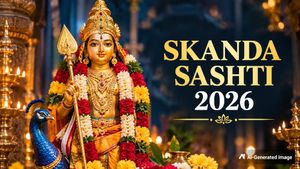 Skanda Sashti 2026: Significance, Vrat Rituals And How Devotees Observe The Day
 -
 Saraswati Avahan 2026: Significance, Shubh Muhurat, Rituals And Puja Vidhi
 -
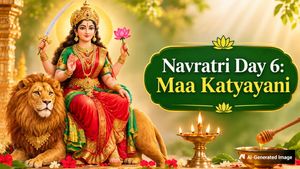 Navratri Day 6: Maa Katyayani Puja, Colour, Rituals, And Significance
 -
 Garba Before The DJ Era: What Navratri Looked Like In Earlier Times
 -
 What Does Indian Design Mean Today? A Creative Director Explains
 -
 Why Your Vision Can Feel Different In Bright And Dim Rooms, Expert Explains
 -
 Pandal Hopping In Bengaluru 2026: 7 Durga Puja Venues Worth Your Time
 -
 Navratri 2026 Fasting Food: Is Daily Sabudana Really the Best Choice?


Surayya Tyabji: The Woman Behind India’s Final Flag Design Who History Nearly Forgot

When you see the Indian tricolour fluttering in the breeze, saffron, white and green, with the deep blue wheel at its heart, there's one name almost no schoolbook mentions: Surayya Tyabji. Yet, it was Surayya who helped shape the final version of the Indian national flag that we know today, a symbol of unity and identity that millions hold dear.
More Than a Footnote: Who Was Surayya Tyabji?

Born in 1919 in Hyderabad, Surayya Tyabji lived in a household that was known for its progressive thoughts and citizen activism. She was an artist, a modern thinker, and went on to join various committees that were formed at a later stage as part of the Constituent Assembly of India, the body that drafted the Constitution and finalised key national symbols in 1947.
Her husband, Badruddin Tyabji, was a civil servant who later became Vice-Chancellor of Aligarh Muslim University. Together, they worked on committees set up by Prime Minister Jawaharlal Nehru to figure out what India's flag and emblem should look like as the country prepared for independence.
What Did She Actually Do?
- While Pingali Venkayya is widely credited with designing early versions of the Indian flag under the Indian National Congress, those versions featured the charkha (spinning wheel) and were tied to the independence movement.
- As independence neared in 1947, leaders felt the flag needed a version that would represent all Indians, beyond party symbolism. That's when a committee was formed to finalise the design.
- According to family histories and research by historians and organisations studying the flag's origins, it was Surayya Tyabji who suggested replacing the charkha with the Ashoka Chakra, the wheel from Emperor Ashoka's Lion Capital at Sarnath, because it was a symbol rooted in India's ancient, inclusive heritage.
- She also supervised the stitching of the very first version of the new flag and specified the colours and fabric, small but meaningful choices that helped shape the final symbol.
- That design was unanimously accepted by the Constituent Assembly on 22 July 1947 and became the official flag of independent India.
Why the Ashoka Chakra Matters

The Ashoka Chakra, a 24-spoke blue wheel, didn't just replace the charkha for decoration. It was chosen for what it represents: the idea of life in motion, progress, justice and dharma (righteousness). Today, it is a visual reminder that India's journey is one of constant movement forward, not stagnation.
Why Isn't Surayya Better Known?
Here's where history and popular memory diverge. Official records from the Constituent Assembly don't name individual contributors in its resolutions, and most textbooks still credit Pingali Venkayya as the flag's designer because his early version inspired later ones.
But historians studying archival material, family accounts, and research by independent organisations suggest that Surayya's role, especially in defining the final form of the flag, deserves recognition. That includes her artistic contribution to the emblem and her oversight of the first flag's creation.
Her daughter, Laila Tyabji, a noted crafts activist, has described how her parents worked on the design under Nehru's instructions, blending ancient symbolism with modern identity.
Remembering the Woman Behind the Tricolour
Surayya Tyabji's story shows us that history isn't always written with every name included. Many important contributions, especially by women, never make it to textbooks.
So when you look at the Indian flag, it's worth remembering that behind its colours, and the Ashoka Chakra, was a woman who helped shape India's identity.

 Continue with Google

