




 Click it and Unblock the Notifications


Latest Updates
-
 India’s Young Workforce May Face Heart Risks Even With A Normal BMI, Heart Health Report 2026 Finds
 -
 Aishwarya Rai Bachchan Serves Dark Queen Glamour At L’Oréal Paris Le Défilé 2026
 -
 Pitru Paksha 2026: Does Ancestor Worship Bring Bad Luck If Rituals Aren’t Performed? Astrologer Explains
 -
 World Heart Day 2026: Think You Are Fit? Your Heart May Tell a Different Story
 -
 Dawn Phenomenon vs Somogyi Effect: What's The Difference?
 -
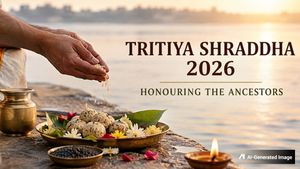 Tritiya Shraddha 2026: Who Should Perform It, Rituals To Follow And Why The Day Holds Significance
 -
 World Heart Day 2026: The Heart Attack That Doesn't Look Like a Heart Attack
 -
 Vighnaraja Sankashti Chaturthi 2026: Know The Date, Significance, Vrat Katha And Moonrise Fasting Rituals
 -
 Taylor Swift Makes VMA History: All About Her Record-Breaking Night And Striking Red Carpet Look
 -
 Bank Holidays October 2026: Check State-Wise List Before Visiting Your Branch


Toasts

"My round...Good health...Here's to us...Cheers..."
Familiar rituals, but have you ever thought why we talk about a 'round' of drinks? Why we associate drink with health? Why a toast is called a 'toast'?
The answer comes from the ritual of drinking - from ancient times and among primitive as well as 'civilized' peoples - sitting around in a circle. Think of Roman banquets. Think of the Plains Indians of North America and their pipes of peace. Contemporary Mongolian nomads sit round a central fire in their tents, called 'gers', and steadily down pots of fermented mare's milk and homemade vodka.
Prost. Slainte. Skol. Sante. Salute. Salud. Na-strovia. Nazdrave. Sakh-tain and all its Arab variants. Kampai, and all its Far Eastern variants... Here's health. Health to you. Good health... The most familiar and frequent salutation upon receiving a drink - apart from 'cheers', which we will look at in a moment, properly applied only to spirits - in Scotland - 'Slainte'. (Pronounced: Slan-juh)
'Cheers' is obliquely related. The word derives from the Anglo-Norman 'chere' meaning 'face'. As early as the 13th century this had become a metaphor for the state of mind behind it, hence 'be of good cheer', 'be cheerful', 'cheers'.
The origin of meaning of 'toasts' is more obscure. The word derives from the Vulgar Latin tostare (to scorch or roast - i.e. toast ). From Classical times it was common to flavour wine by floating small pieces of toasted bread in it. Sometimes these sippets would be flavoured with spices; at other times the carbon alone would mellow the wine, in exactly the same way that the char on the walls of an American barrel removes harsh and sulphury notes in new make whisky.
It is believed that the drinking of 'toasts' derives from the gallantry that 'the name of the lady (to whom one was drinking) enhanced the drink more than any toast'. This usage first appears in the 17th century.
Toasting is still with us, of course, although in a debased form. During its Golden Age (the late 18th century) it was endemic: no glass was drunk without being dedicated to someone, something or some cause. During one of the banquets thrown in Edinburgh during George IV's 'jaunt' to his northern kingdom in August 1822, forty-seven toasts were proposed and drunk. But this is worthy of an essay in itself. And of course, we talk of 'rounds' of toasts.
I hope to share more on this subject with a select audience of interested scotch drinkers when I visit India in November.

 Continue with Google

