




 Click it and Unblock the Notifications


Latest Updates
-
 World Smile Day 2026: 5 Ways Smiling May Benefit Your Health And Support Everyday Wellbeing
 -
 Lal Bahadur Shastri Jayanti 2026: 10 Quotes That Reflect His Ideas On Leadership, Peace And Nation-Building
 -
 Gandhi Jayanti 2026: 10 Places In India Where You Can Experience Mahatma Gandhi’s Legacy
 -
 International Day Of Non-Violence 2026: Why Was Gandhiji's Birthday Chosen For A Global Message Of Peace?
 -
 Saptami Shraddha 2026: Who Should Perform It And What Does This Pitru Paksha Ritual Mean?
 -
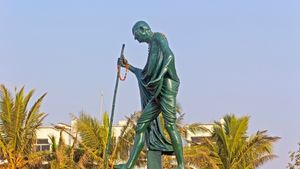 Gandhi Jayanti 2026: 7 Sustainable Lifestyle Lessons We Can Still Learn From Gandhi
 -
 Who Is Captain Smit Machchhar? The Pilot Who Fought Back Mid-Air on Flydubai FZ1073
 -
 Toys For Kidults And ToyTrends: Inside The Spielwarenmesse 2027 Preview
 -
 How Do You Tell Normal Stress From Something More Serious? Expert Explains
 -
 International Coffee Day 2026: 7 Ways To Make Your Morning Coffee Healthier Without Losing Taste


Jantar Mantar Protest On Gandhi Jayanti 2026: Why This Delhi Landmark Is A Hub For Public Demonstrations

Jantar Mantar is in the news on Gandhi Jayanti 2026 as activists, student groups and political leaders gather in Delhi to protest against the functioning of the Election Commission and demand action against Chief Election Commissioner Gyanesh Kumar. The demonstration is linked to concerns over the Special Intensive Revision (SIR) of electoral rolls.

Delhi Police denied permission for the gathering and imposed restrictions under Section 163 of the Bharatiya Nagarik Suraksha Sanhita, while security was tightened around the area. Several protesters were detained as police moved to prevent the unauthorised gathering.
But Jantar Mantar's story began long before it became associated with demonstrations. The Delhi landmark was built in 1724 as an astronomical observatory, making its journey from a centre for studying the skies to a prominent public protest venue an unusual part of the capital's history.
Jantar Mantar Was Built To Study The Skies
Located on Parliament Street near Connaught Place, Jantar Mantar was commissioned by Maharaja Sawai Jai Singh II of Jaipur. He built a network of observatories in Delhi, Jaipur, Ujjain, Varanasi and Mathura to improve astronomical observations and calculations.
The enormous masonry instruments were designed to track celestial bodies and determine measurements related to time and the position of the Sun and other heavenly objects. The structures remain the defining feature of the site, although modern construction around the observatory has affected its ability to make accurate astronomical observations.
When Did It Become A Protest Venue?
The site's connection with public demonstrations emerged more than two centuries after its construction. According to The Indian Express, Jantar Mantar became a designated protest location in 1993.
Before this shift, the area around the Boat Club near India Gate was a major gathering point for large demonstrations. The scale of some protests, including the farmers' mobilisation in 1988, contributed to changes in how and where demonstrations were organised in central Delhi.
Why Is Jantar Mantar Suitable For Protests?
Its location is a major reason. Jantar Mantar sits close to Parliament and the central government district, placing demonstrations near the country's political centre.
At the same time, having a designated area for protests allows authorities to establish boundaries, regulate crowds and manage traffic. Over the years, this has made Jantar Mantar a familiar setting for demonstrations involving a wide range of public issues.
A Landmark With Two Very Different Histories
Jantar Mantar carries two distinct identities. Its monumental instruments preserve an important chapter in India's history of astronomy, while its location has made it a prominent venue for public demonstrations since the 1990s.
The latest protest on Gandhi Jayanti 2026, involving student organisations, activists and political groups, adds another chapter to that history. Their presence at the landmark once again highlights how Jantar Mantar has evolved from a place designed to observe the skies into a space where people gather to bring public issues into view.
That transformation makes Jantar Mantar more than a historic monument. Its story has continued to change with the city and the issues occupying public attention.

 Continue with Google

